On this page
Wolverine peptide stack: original vial COA
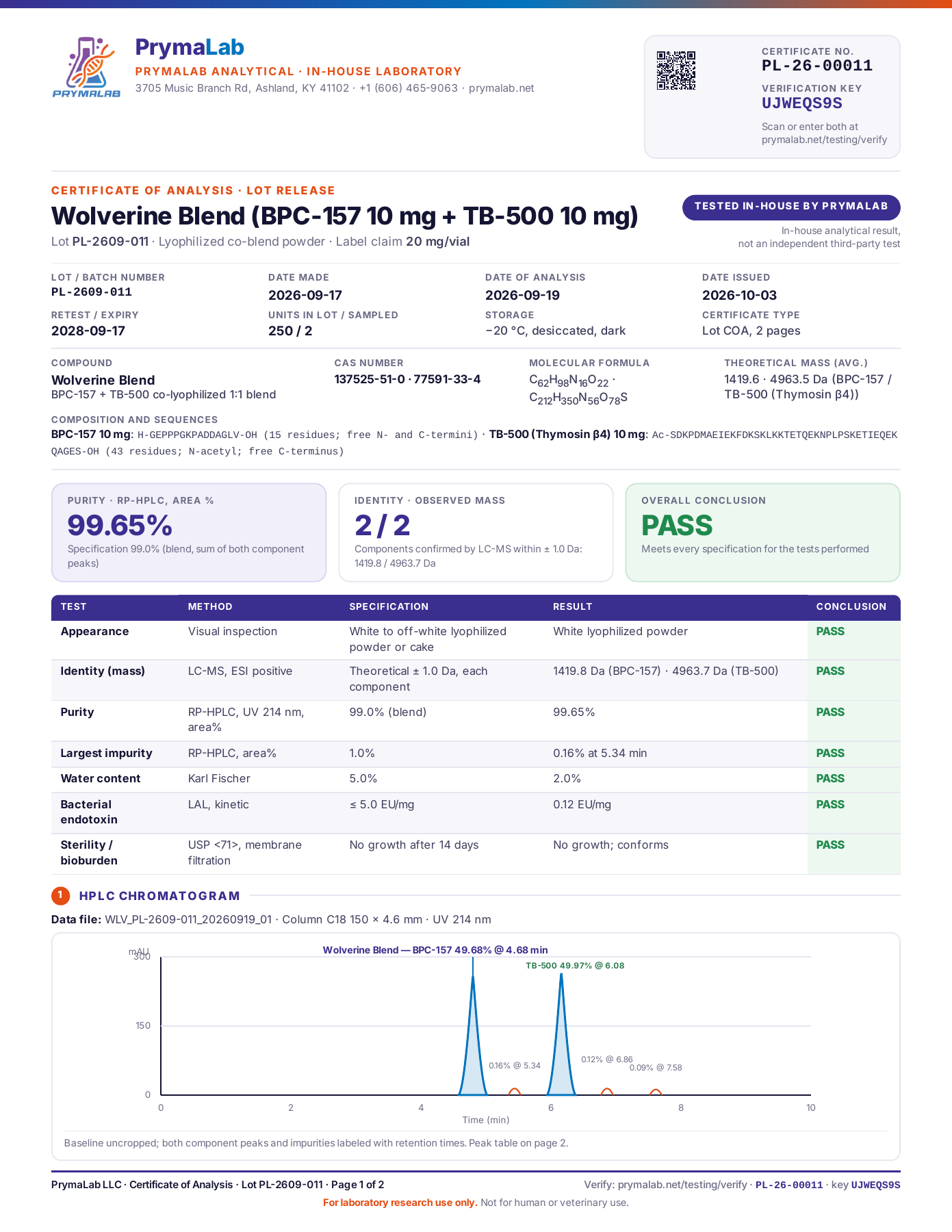
The certificate below records the reported analytical results for Wolverine Blend 20 mg, lot PL-2609-011. It is the original two-page PDF, including the test summary, chromatogram, method details and laboratory approvals. The report identifies the testing as in-house.1
Wolverine Blend 20 mg
- Lot number
- PL-2609-011
- Certificate number
- PL-26-00011
- Reported HPLC area purity
- 99.65%
- Reported identities
- 2 of 2 components
- Testing laboratory
- In-house
Original document · 2 pages · named lyophilized vial lot
Start with the lot number when connecting a report to a product. A certificate title identifies the blend, while the lot number identifies the batch described by the document. Keep both pages together when saving or reviewing it: the first page presents the results and the second supplies the supporting method and review record.
Keep both report pages together
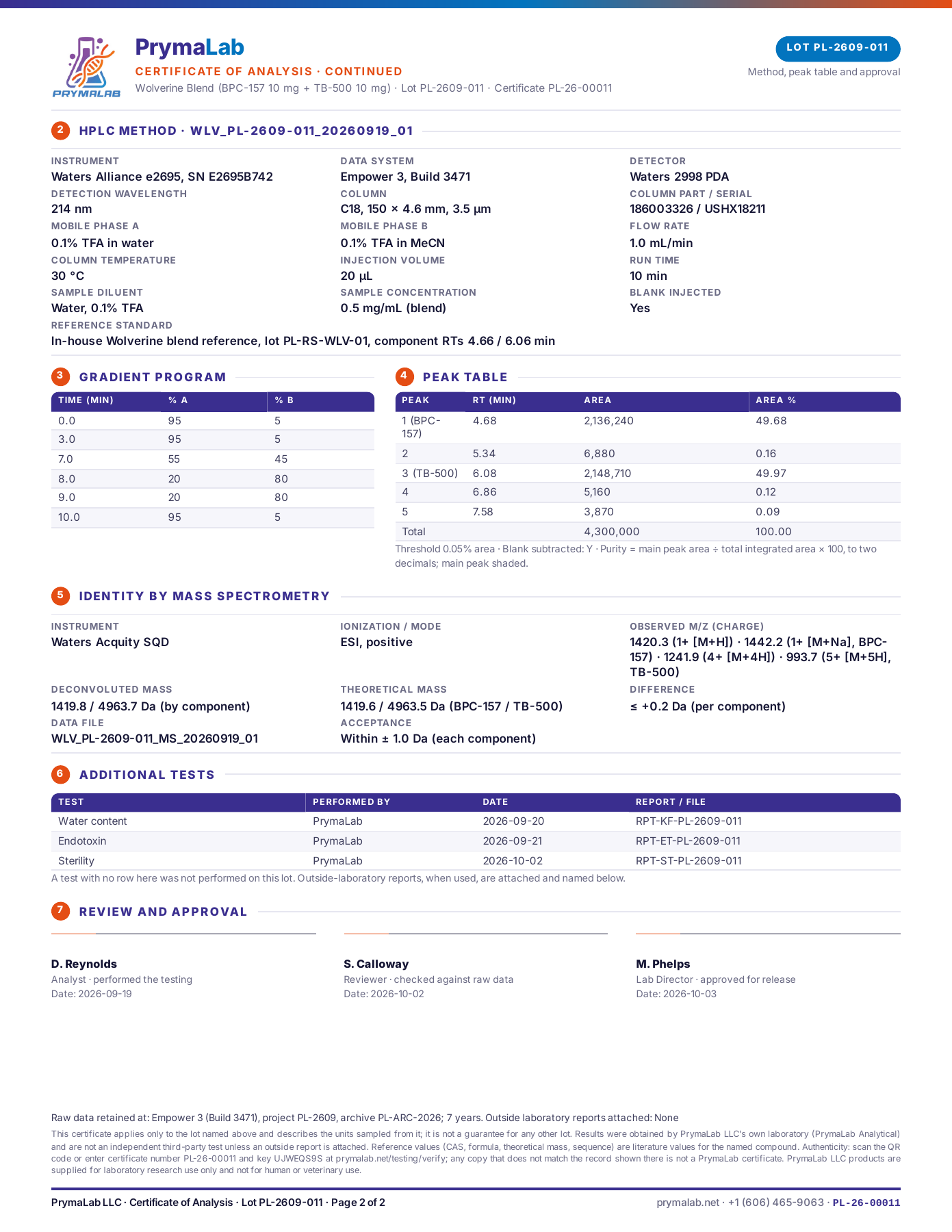
The second page contains the method and supporting records. The original PDF includes both pages.
Open page two ↗What the Wolverine vial report says
The table preserves the measurement units and method labels used in the supplied report. These are reported laboratory results for the named lot, rather than measurements independently repeated by this website.1
| Test | Reported result | Method in the certificate |
|---|---|---|
| Appearance | White lyophilized powder | Visual inspection |
| BPC-157 identity | 1419.8 Da | LC-MS, positive ESI |
| TB-500 identity | 4963.7 Da | LC-MS, positive ESI |
| Blend purity | 99.65% area | RP-HPLC, UV detection at 214 nm |
| Largest reported impurity | 0.16% area at 5.34 minutes | RP-HPLC |
| Water content | 2.0% | Karl Fischer |
| Bacterial endotoxin | 0.12 EU/mg | Kinetic LAL |
| Sterility / bioburden | No growth; conforms | USP <71>, membrane filtration; 14-day criterion |
The certificate records a PASS conclusion against its listed specifications. Read that conclusion together with the individual results, methods and sample information. It describes the tests performed; it is not a score for recovery outcomes.
How the certificate identifies the two ingredients
The report describes a co-lyophilized, equal-weight blend containing 10 mg BPC-157 and 10 mg TB-500. Its sequence field lists BPC-157 as a 15-residue peptide. For TB-500, the document names thymosin beta-4 and lists a 43-residue, N-acetylated sequence. This identifies the form described by this particular certificate.1
The LC-MS section reports observed masses of 1419.8 Da and 4963.7 Da, respectively. The listed theoretical masses are 1419.6 Da and 4963.5 Da, with an acceptance window of ±1.0 Da for each component. Both reported differences fall within that window.1
Identity and quantity answer different questions. FDA's quality-testing overview distinguishes identification of the stated substance from an assay that measures how much is present, and from impurity testing. That distinction is useful when reading any peptide certificate.2
What 99.65% HPLC area purity means
The certificate reports 99.65% RP-HPLC area purity for the blend, using the two component peaks. The chromatogram plots detector response over time; the associated peak table records retention times and integrated peak areas. The report specifies UV detection at 214 nm.1
20 mg describes the stated contents
The vial's composition is 10 mg BPC-157 plus 10 mg TB-500. The two values add to the stated 20 mg total blend.
99.65% describes the reported area result
This percentage belongs to the chromatography result. It should remain labeled as HPLC area purity when reproduced in a product specification.
A content assay and an impurity result have different purposes. Avoid converting an area percentage into a verified milligram amount simply by multiplying it by the label claim. FDA describes an assay as the measurement used to assess the amount of drug against its labeled quantity.2
The same care applies to the phrase “1:1 blend.” Here it describes equal stated ingredient weights. Keep that composition statement separate from the two HPLC peak areas and the individual molecular masses. Combining these numbers into a single quality percentage would make the specification harder to interpret.
Water, endotoxin and sterility results
Water content: the certificate reports 2.0% using Karl Fischer testing. This is a separate result from chromatographic purity and appears as its own row in the laboratory summary.1
Endotoxin: the reported result is 0.12 EU/mg by kinetic LAL testing. EU expresses endotoxin activity; the denominator here is milligrams of material. Preserve the full unit when recording or sharing the result so it is not mistaken for a concentration per milliliter.13
Sterility / bioburden: the document lists membrane filtration under USP <71> and reports no growth against its 14-day criterion. This result is attached to the sampled material and the test described in the certificate.1
Microbial testing and endotoxin testing are separate because they assess different concerns. FDA's technical discussion explains that reducing microorganisms does not necessarily produce a corresponding reduction in endotoxin. One result should therefore not be used as a substitute for the other.3
Lot numbers, dates and laboratory methods
The report records 250 units in the lot and 2 units sampled. It gives September 17, 2026 as the manufacturing date, September 19, 2026 as the analysis date, and October 3, 2026 as the issue date. The listed retest / expiry date is September 17, 2028.1
Page two names the instruments, data files and reference material used in the reported work. The HPLC record includes a C18 column, detector wavelength, mobile phases and gradient program. The mass-spectrometry record includes the observed ions and the masses assigned to each component. Those details connect the headline results to a documented analytical procedure.1
- Match the record: use the product name, lot number and certificate number together.
- Retain the units: record area%, Da, EU/mg and other measurements exactly as labeled.
- Keep the complete PDF: a cropped purity badge leaves out the method and sample context.
- Check the document used: a later lot should be reviewed against its own corresponding records.
For a question about this document, quote PL-2609-011 / PL-26-00011 in your message to [email protected]. That makes it clear which report and measurement need attention.
Wolverine peptide stack product specifications
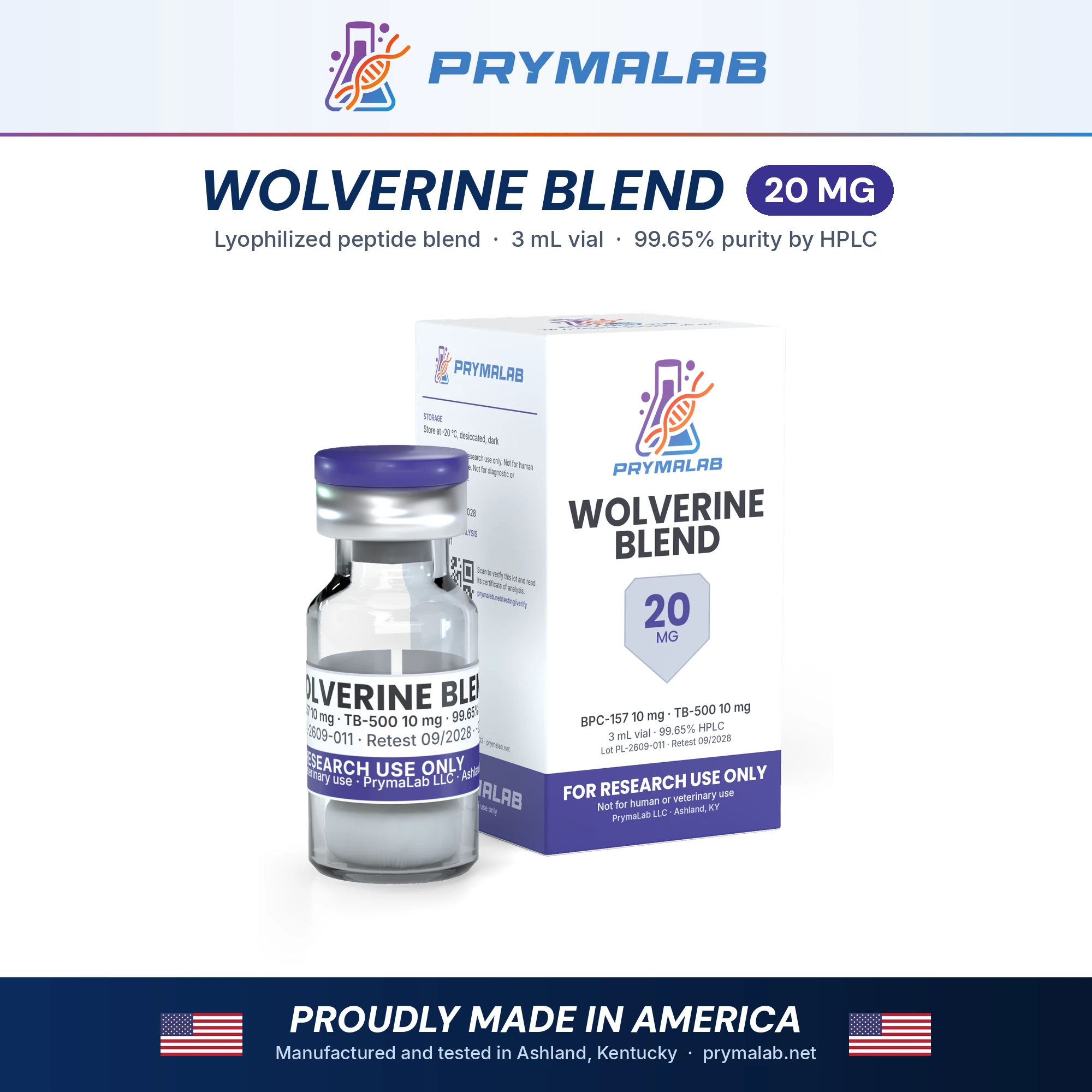
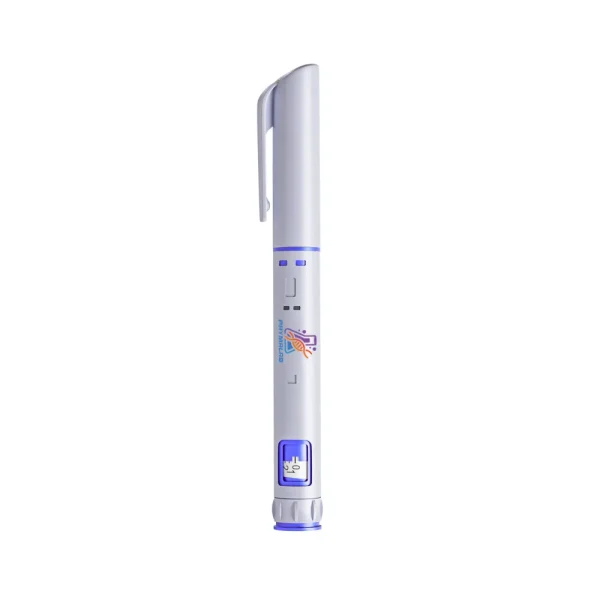
The website lists two formats with equal ingredient amounts by weight. The 20 mg vial contains 10 mg BPC-157 plus 10 mg TB-500. The 40 mg preloaded pen contains 20 mg BPC-157 plus 20 mg TB-500 in 3 mL.
The vial is freeze-dried material; the pen specification describes a preloaded liquid. Keep the amount of peptide, the physical format and any stated solution volume in separate fields when reviewing product information. The dosage and quantity guide explains the distinction between total blend, per-ingredient amounts and concentration.
Use the product page for the two format specifications, and Benefits & Research for the evidence behind recovery-related claims. Analytical documentation describes material and test results; clinical research addresses outcomes such as pain, movement and recovery.
Wolverine peptide COA questions
Where can I download the original Wolverine vial COA?
Open the original two-page vial PDF. The file includes both the results page and the method, peak-table and approval page.
What purity does this certificate report?
It reports 99.65% RP-HPLC area purity for the Wolverine Blend vial lot PL-2609-011. The percentage is presented as a chromatography result, alongside separate identity and additional-test results.1
What information should I include in a document question?
Include the lot number, certificate number and the result or page you are asking about. For this report, use PL-2609-011 and PL-26-00011. You can reach us through the contact page.
Sources and Original Documentation
- 1Original Wolverine Blend 20 mg vial certificateLot PL-2609-011; certificate PL-26-00011. Two-page in-house analytical report reproduced as supplied.
- 2FDA — Drug Quality Sampling and Testing ProgramsPrimary explanation of identity, assay and impurity testing as distinct quality attributes.
- 3FDA — Bacterial Endotoxins/PyrogensTechnical background on endotoxin activity units and the distinction between microbial and endotoxin results.